
Recruitment & Hiring in India: A Practical Guide for Employers
RECRUITMENT AND HIRING
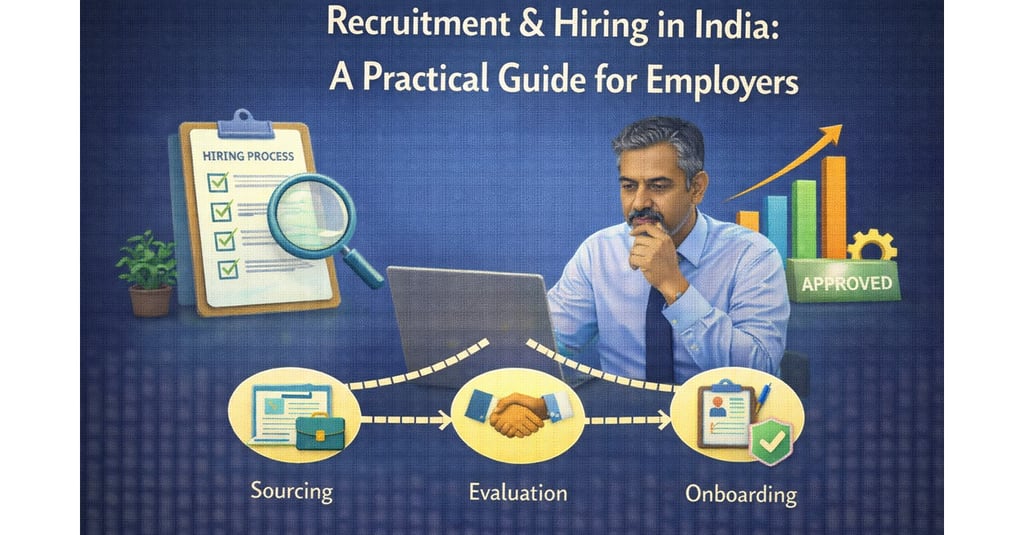
Introduction--
Once a candidate accepts an offer, the period between acceptance and joining becomes a critical phase in the recruitment lifecycle. This pre-joining window influences whether a candidate actually joins, how prepared they feel on Day One, and how quickly they settle into the organisation. For HR, effective pre-joining engagement and onboarding planning are essential to convert offers into confident, committed employees.
This article outlines practical approaches HR teams can adopt to manage pre-joining engagement and establish strong onboarding foundations—without overcomplicating the process.
Recruitment and hiring form the foundation of every organisation’s people strategy. In the Indian context, hiring is shaped by a large and diverse talent pool, varying skill readiness, regional and cultural differences, competitive labour markets, and increasing regulatory awareness. For HR teams and business leaders, recruitment is not just about filling open positions quickly, but about making balanced decisions that support productivity, stability, and long-term growth.
A disciplined recruitment approach helps organisations reduce attrition, control costs, maintain compliance, and build teams that can perform in real Indian operating conditions. This article sets out a practical, end-to-end view of recruitment and hiring from an Indian HR perspective.
Recruitment & Hiring in the Indian Organisational Context
Indian organisations operate at very different levels of maturity — from early-stage startups to family-run SMEs, professional enterprises, and large factories. As a result, recruitment practices vary widely, but certain realities are common:
High competition for skilled and experienced talent
Large volumes of entry-level and frontline hiring
Wide compensation expectations and negotiation behaviour
Skill gaps between qualifications and job readiness
Pressure to hire fast due to business demands
Recruitment systems must therefore be flexible, structured, and grounded in business reality rather than ideal processes copied from global models.
Core Elements of an Effective Recruitment Framework
Manpower Planning and Role Clarity
Recruitment should begin with clarity on why a role is required. HR teams must ensure that hiring requests are linked to workload, growth plans, or replacement needs. Poorly defined roles often lead to wrong hires, early exits, and role confusion.
Clear role definition includes:
Purpose of the role
Key responsibilities and deliverables
Required skills versus trainable skills
Reporting structure and decision authority
Talent Sourcing in India
Sourcing strategies depend on role type, urgency, and talent availability. Indian employers typically rely on a mix of:
Job portals and online platforms
Employee referrals
Recruitment consultants and staffing agencies
Campus hiring and apprenticeships
Local sourcing for factory and frontline roles
HR must evaluate sourcing channels based on quality, cost, speed, and reliability rather than convenience alone.
Screening and Selection Discipline
Resume screening and shortlisting require structured criteria. In India, factors such as role relevance, employment stability, location constraints, and realistic salary alignment matter significantly.
Interviews should be planned and consistent. Unstructured or casual interviews often result in biased decisions or skill mismatches. For many roles, practical assessments and situational discussions provide better insight than theoretical questioning.
Offer Management and Candidate Closure
Offer stages are sensitive in the Indian market. Candidates often negotiate aggressively, seek role or location changes, or delay joining. Clear communication is critical.
Effective offer management includes:
Transparent CTC structures
Clear explanation of fixed and variable pay
Written offers with defined joining dates
Realistic handling of counter-offers and delays
Poor offer practices are a major cause of hiring failures.
Pre-Employment Checks and Documentation
Before onboarding, organisations must complete basic verification and documentation to reduce legal and operational risks. This includes identity checks, qualification verification, experience confirmation, and collection of statutory information.
Skipping or delaying these steps may create compliance exposure later, especially during audits, disputes, or exits.
HR’s Role and Practical Judgement in Recruitment
HR’s role in recruitment goes beyond coordination. HR is responsible for process discipline, fairness, and alignment with organisational values. This includes:
Challenging unrealistic hiring expectations
Ensuring consistent evaluation standards
Balancing speed with quality
Advising managers on compensation and role fit
Protecting the organisation from compliance and reputational risks
Recruitment decisions should be guided by judgement, data, and experience — not urgency alone.
Conclusion
Recruitment and hiring in India require a practical, grounded approach that respects market realities while maintaining structure and fairness. Strong recruitment processes help organisations attract the right talent, reduce avoidable attrition, and support long-term workforce stability.
By focusing on clear role definition, disciplined sourcing and selection, transparent offers, and compliance readiness, Indian employers can turn recruitment from a reactive activity into a strategic capability.
🗹 Recruitment & Hiring Checklist for HR Teams
🗹 Validate manpower requirement before initiating hiring
🗹 Define role responsibilities and success criteria clearly
🗹 Select sourcing channels based on role and urgency
🗹 Apply structured screening and shortlisting criteria
🗹 Use consistent and fair interview practices
🗹 Assess practical skills relevant to Indian work conditions
🗹 Ensure compensation alignment and internal parity
🗹 Issue clear, written offers with defined terms
🗹 Manage negotiations and joining timelines proactively
🗹 Complete pre-employment verification and documentation
Key Stages of Recruitment & Hiring in India
Conclusion--
Effective labour law compliance depends on how well HR operations, payroll, and business processes work together. When compliance is embedded into everyday workflows, organisations reduce risk, improve accuracy, and build sustainable governance systems. HR teams that prioritise integration over isolation are better positioned to manage compliance confidently and consistently.
HireDesk India © 2026 | All Rights Reserved
"Thoughtful guidance for everyday HR"


Quick Links
Topics
Connect
_______________________________________________________________________________________________________________________________________________________________________________________
HireDesk is a free HR knowledge platform focused on practical, India-specific workplace guidance. We help HR professionals, managers, and learners navigate people practices with clarity, responsibility, and real-world relevance.