
Understanding Labour Law Compliance for Indian Employers
COMPLIANCE & LABOUR LAWS
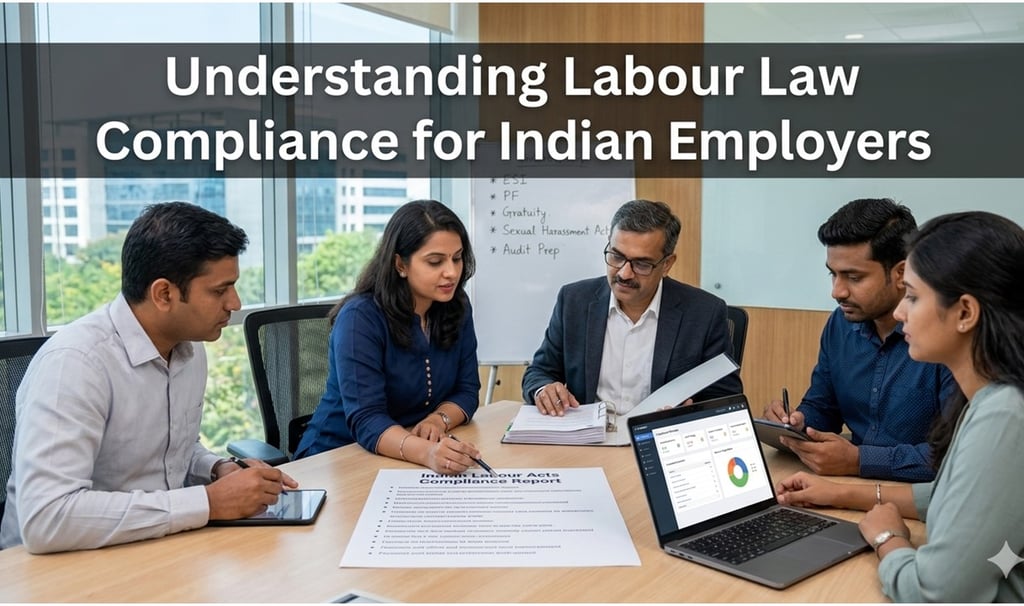
Labour law compliance in India is not limited to filing returns or responding to inspections—it is an ongoing responsibility that shapes how organisations manage people, risks, and workplace governance. With multiple central and state laws, varying applicability thresholds, and periodic amendments, compliance can often feel complex and fragmented for HR teams.
This pillar article provides a structured understanding of labour law compliance from an HR perspective. It explains what compliance means in practice, how different laws apply, and the role HR plays in building compliant systems—while recognising that compliance management is not the same as providing legal advice or interpretation.
What Labour Law Compliance Means in Practice
At its core, labour law compliance refers to an organisation’s responsibility to follow applicable employment-related laws governing wages, working conditions, social security, industrial relations, and employee welfare.
For HR, compliance involves:
Understanding which laws apply to the organisation
Translating legal requirements into internal processes
Maintaining accurate records and documentation
Coordinating with external advisors where required
Compliance is not a one-time activity—it is a continuous HR function embedded in everyday operations.
Central and State Labour Laws: Applicability Basics
Indian labour laws operate at both central and state levels. While central laws provide a broad framework, state rules often define implementation details, thresholds, and procedures.
Applicability typically depends on:
Number of employees
Nature of establishment (factory, shop, office, etc.)
Location and state-specific rules
Type of employment arrangements
HR teams must therefore track not just what laws exist, but where and when they apply.
Core Compliance Areas Typically Managed by HR
While legal interpretation may rest with professionals, HR is usually responsible for operational compliance across key areas such as:
Wage and salary administration
Working hours, leave, and attendance
Statutory benefits and social security
Employment records and registers
Policy communication and implementation
Gaps in these areas often expose organisations to compliance risks—even when intent is sound.
Common Compliance Gaps and Risk Areas
Many compliance issues arise not from deliberate non-compliance, but from process gaps and assumptions.
Common risk areas include:
Misunderstanding applicability thresholds
Delayed updates after legal changes
Incomplete or inconsistent documentation
Over-dependence on external consultants without internal understanding
Lack of coordination between HR, payroll, and operations
Identifying these gaps early allows HR to move from reactive correction to proactive compliance management.
Building a Sustainable Compliance Approach
Sustainable compliance relies on systems, not firefighting. HR teams can strengthen compliance by:
Maintaining a clear compliance responsibility matrix
Scheduling periodic internal reviews
Keeping documentation and registers updated
Training HR and line managers on basic compliance awareness
Engaging external advisors selectively and purposefully
A structured approach reduces stress, risk, and last-minute escalations.
Labour Law Compliance Readiness Checklist for HR
Use this checklist as a periodic self-review tool:
Applicability & Awareness
☐ Applicable central and state laws identified
☐ Thresholds and exemptions reviewed periodically
☐ Legal updates tracked through reliable sources
Process & Documentation
☐ Statutory registers and records maintained accurately
☐ Policies aligned with current legal requirements
☐ Payroll and attendance systems integrated with compliance needs
Coordination & Review
☐ Clear ownership defined within HR
☐ Periodic internal compliance reviews conducted
☐ External advisors consulted where interpretation is required
How This Article Connects to Related Topics
This pillar article lays the foundation for deeper discussions on specific compliance themes, including:
Common compliance mistakes organisations make
Central versus state law differences in practice
Managing compliance alongside HR operations and payroll
Building awareness without legal overreach
Together, these articles help HR professionals approach compliance with clarity and confidence.
Conclusion
Labour law compliance is most effective when treated as a structured HR responsibility rather than a reactive obligation. By understanding applicability, responsibilities, and common risk areas, HR teams can build systems that support organisational governance while protecting employee interests. A thoughtful compliance approach enables HR to operate with confidence and credibility in complex regulatory environments.
Conclusion--
Effective labour law compliance depends on how well HR operations, payroll, and business processes work together. When compliance is embedded into everyday workflows, organisations reduce risk, improve accuracy, and build sustainable governance systems. HR teams that prioritise integration over isolation are better positioned to manage compliance confidently and consistently.
Related Articles
HireDesk India © 2026 | All Rights Reserved
"Thoughtful guidance for everyday HR"


Quick Links
Topics
Connect
_______________________________________________________________________________________________________________________________________________________________________________________
HireDesk is a free HR knowledge platform focused on practical, India-specific workplace guidance. We help HR professionals, managers, and learners navigate people practices with clarity, responsibility, and real-world relevance.